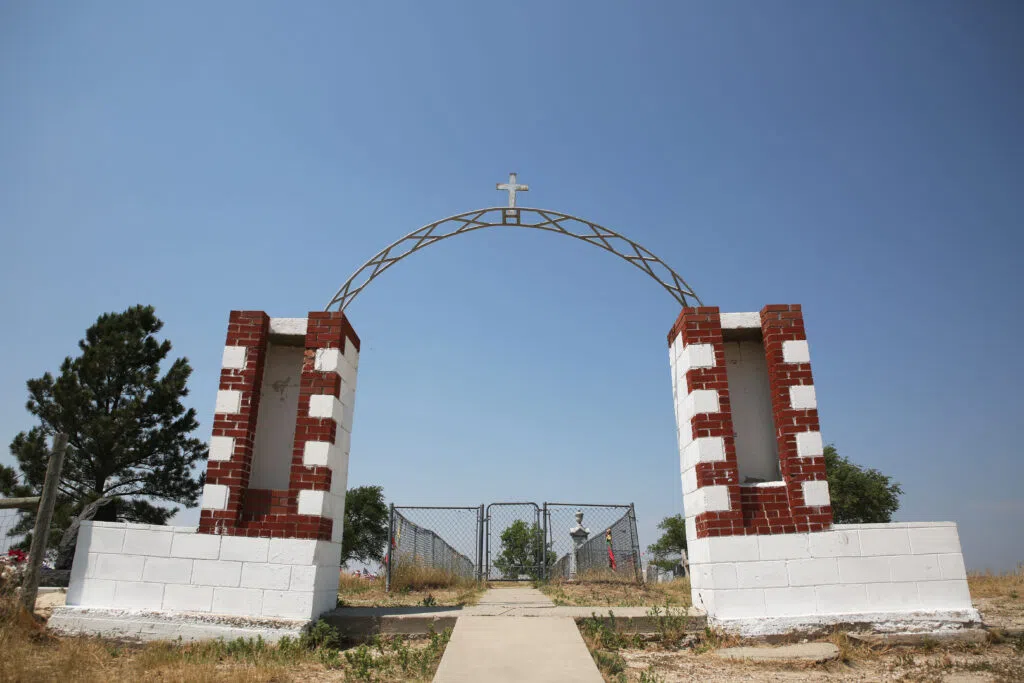
An arch topped with a cross marks the entrance to the Wounded Knee Memorial and cemetery on the Pine Ridge Reservation on June 30, 2024. (Makenzie Huber/South Dakota Searchlight)
WOUNDED KNEE, S.D. (South Dakota Searchlight) – For Violet Catches, the Defense Department’s decision not to rescind the Medals of Honor awarded to soldiers who were at the 1890 Wounded Knee Massacre was a gut punch.
“I cried,” said Catches, a descendant of survivors and a member of the Cheyenne River Sioux Tribe.
Catches said one of her great-grandfathers was killed at the massacre and buried in the mass grave. Other relatives survived and shared stories of the carnage.
“This is not an easy story to tell,” Catches said through tears.
But Catches and other descendants of survivors and their advocates plan to continue pushing to revoke the medals, even though the recent decision by the Department of Defense was another setback after multiple past attempts at congressional action failed.
“We are not going to quit,” Catches said. “We want healing for our youth, for our grandkids.”
The U.S. Senate Armed Services Committee boosted the effort this week in a report about the committee’s version of the National Defense Authorization Act for fiscal year 2027. U.S. Sen. Mike Rounds, R-South Dakota, said in a news release that the report’s language directs the secretary of defense to “provide the full report and unredacted materials” from the department’s recent review of the medals.
The committee report says the department “has announced the results of the review but not explained what it did and did not consider as part of the review process.”
“Numerous stakeholders, including descendants of the Wounded Knee victims, have expressed concern about precisely which historical sources, experts, and bodies of law were considered in this review,” the committee report says. Further language in the report directs the secretary of defense to provide a briefing about the medals review to both congressional Armed Services committees by Feb. 1.
OJ Semans, a Rosebud Sioux Tribe member, has supported past congressional efforts to rescind the medals and has worked to educate individual members of Congress about the massacre. He plans to continue doing that.
“Until they’re able to read about that injustice, or read about those atrocities, there will be no justice,” Semans said.
A step forward and back
The latest setback came after what appeared to be a step forward.
In 2024, the Department of Defense under President Joe Biden created a panel to review the medals. At the time, the department said about 20 soldiers who were at the massacre had received a Medal of Honor for their actions. The number is debatable because records associated with some of the medals are incomplete or unclear.
The department did not announce or publish the panel’s findings or recommendations before Biden left office.
In September, President Donald Trump’s defense secretary, Pete Hegseth, announced in a social media video that the medals will not be rescinded. He called the massacre a “battle” and said the soldiers “deserve those medals.”
The five-member panel included three people appointed by the Department of Defense and two appointed by the Department of the Interior. In a written report obtained recently by South Dakota Searchlight, the panel’s Defense-appointed chairman wrote, “While the actions of leadership were suspect, circumstances chaotic, and non-combatants tragically killed, three of the five panel members believe that individual soldiers distinguished themselves in action and found no disqualifying information.”
One of the Interior-appointed panelists, Wizipan Little Elk Garriott, a member of the Rosebud Sioux Tribe in South Dakota, told Searchlight that the Defense panelists “were looking for evidence that individuals committed war crimes, essentially.”
“The broader question — that this was a massacre in which women and children were killed and therefore not deserving of medals — was simply not part of the conversation,” Garriott said.
‘Purposeful yet indiscriminate killing’
Wendell William Yellow Bull, a member of the Oglala Sioux Tribe whose great-grandfather survived the massacre, said Hegseth’s use of the word “battle” reflected a lack of understanding.
“You don’t disarm people and then call it a battle,” Yellow Bull said.
Brad Upton, of Colorado, is a descendant of Col. James Forsyth, commander of the 7th Cavalry at Wounded Knee. Upton supports revocation of the medals and also sees a need for more education.
“It’s horrific,” he said. “First of all, the U.S. government has never stopped calling it a battle. It was not a battle. It was a massacre.”
The location of the Wounded Knee Memorial and massacre site in southwestern South Dakota.
The massacre occurred after decades of hostilities, during which the U.S. government agreed to an 1868 treaty recognizing Lakota authority over western South Dakota. Under pressure from reports of gold in that region’s Black Hills, the government broke the treaty in the 1870s and eventually forced Lakota people onto smaller reservations.
On the morning of Dec. 29, 1890, a band of about 370 Lakota people was camped near Wounded Knee Creek in southwestern South Dakota while traveling to the Pine Ridge Reservation. The mix of men, women and children hoped to find safety there, according to historian Jerome Greene, author of “American Carnage: Wounded Knee, 1890.”
About 470 members of the Army’s 7th Cavalry — the unit that had been wiped out by Native American warriors at the Battle of the Little Bighorn in 1876 — intercepted and surrounded the Lakota band near Wounded Knee Creek.
Soldiers attempted to disarm the camp, and although “eyewitness accounts differ on particulars,” Greene wrote, somehow a shot rang out. Chaotic shooting ensued.
“However unpremeditated their actions may have been,” Greene wrote of the soldiers, what happened at Wounded Knee “evolved quickly into purposeful yet indiscriminate killing. It became a full-fledged massacre.”
As many as 200 and perhaps more Lakota people died during the massacre or afterward from their wounds, according to Greene. The Army left the bodies to freeze on the ground for several days and then worked with a contractor to bury many of them in a mass grave. Military casualties, including some from friendly fire, numbered 30 killed and another 36 wounded.
Congress passed a resolution expressing “deep regret” for the massacre in 1990, but the medals awarded to soldiers have never been rescinded.
Options for future action
Catches said the apology from Congress is incomplete without rescinding the medals.
“I’m not going to feel like there’s any justice until that happens,” Catches said. “There was nothing honorable about that day.”
Marlis Afraid of Hawk, a Cheyenne River Sioux Tribe member, is the granddaughter of the late Richard Afraid of Hawk, who survived the massacre as a child.
“We’re not going to give up,” she said. “There has to be another way, another avenue, to correct the wrong, what the United States government did, what the 7th Cavalry did to our relatives.”

Dwight Mears, an Army veteran from Oregon with a doctorate in history, has written scholarly articles about the massacre. He said there are several possible ways to rescind the medals.
The Defense Department maintains that the medals are awarded at the president’s discretion. But in a polarized political environment, one administration could revoke a medal and another could restore it, Mears said, making presidential action potentially impermanent.
Mears said Congress could pass legislation to revoke the medals, but that would conflict with laws vesting authority over the adjudication of the Medal of Honor in the executive branch, raising separation-of-powers problems.
Nevertheless, there have been numerous attempts in Congress over the years to rescind the medals. In the current Congress, there are bills from Sen. Elizabeth Warren, D-Massachusetts, and Rep. Jill Tokuda, D-Hawaii.
South Dakota’s all-Republican congressional delegation has not supported those efforts. But this week, Sen. Rounds highlighted the Armed Services Committee’s call for more information on the medal review process, including it in his list of “South Dakota victories” in the committee’s version of the National Defense Authorization Act.
Rounds’ office sent a statement from him in response to South Dakota Searchlight questions about the committee report. The statement described the Defense Department’s decision to uphold the Wounded Knee medals as “final,” but added that “many people with a vested interest in this conflict may legitimately question what sources and materials the department used to come to that judgment. This provision would require a report and a briefing on these materials.”
South Dakota’s delegation also supported a bill signed into law recently that protects the massacre site from being sold, taxed, gifted or leased without approval by Congress and the Oglala Sioux and Cheyenne River Sioux tribes, which jointly purchased the land several years ago.
Mears said Congress has additional options if it decides to pursue the medals issue further. It could propose a change in law giving Congress a veto over military valor awards. That’s unlikely to pass, he said, because it would be unclear how two different branches of government could simultaneously wield the same authority to revoke medals.
Mears said he believes Congress should order another review of the medals with mandated scholarly advice, more historical research and new guidelines for the review.
He said Congress could also pass a law to codify procedures for medal revocation, which would place the process “on firmer footing so that subsequent administrations are unable to unilaterally restore revoked medals out of simple disagreement.”
Efforts to summarily revoke all the medals have not worked, Mears pointed out. He said the best path forward is a careful, case-by-case review.
“Virtually all scholars agree that Wounded Knee was an atrocity and that medals should not have been awarded,” Mears told South Dakota Searchlight in 2024. “I can’t find any Ph.D. claiming otherwise who’s alive.”
He also warned that some medals could survive such a review for lack of specific, disqualifying evidence about an individual soldier. Mears said the bar for awarding a Medal of Honor was much lower at the time. Some of the medals for Wounded Knee were awarded on the basis of a brief note from a commanding officer, leaving little for a modern review panel to consider.




Comments