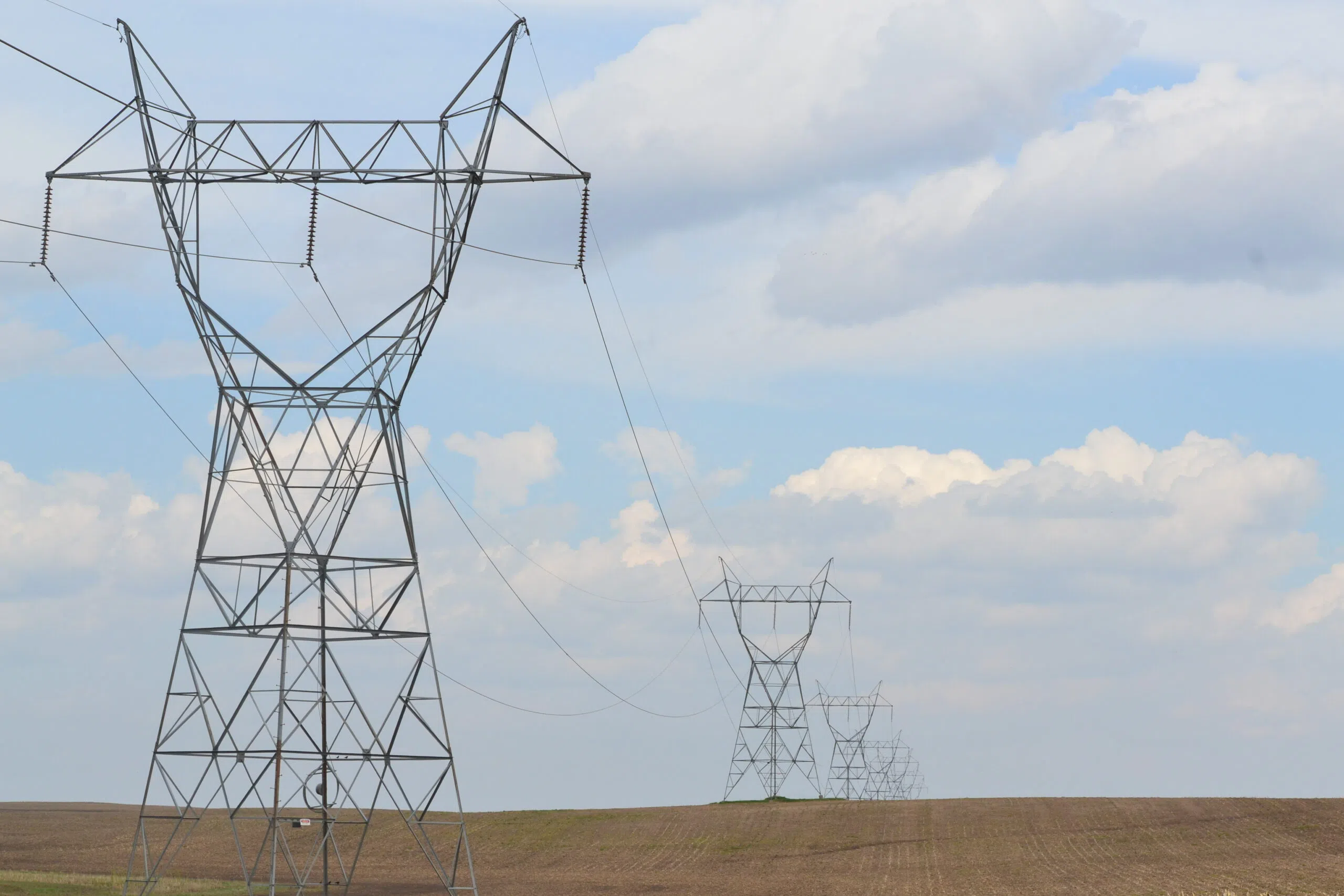
Electric transmission lines cross a field in central North Dakota. (Jeff Beach/North Dakota Monitor)
BISMARCK, N.D. (North Dakota Monitor) – North Dakota electricity rates are the lowest in the country. The six candidates vying for two seats on the state agency that regulates utilities have different ideas on how to keep it that way.
The two incumbents, Jill Kringstad and Sheri Haugen-Hoffart, said they are proud of what the commission has done to make North Dakota energy the cheapest in the United States and don’t see a great need for change.
Haugen-Hoffart attributed the achievement to “great oversight” from the Public Service Commission. Kringstad said they require thousands of pages of data and ask utilities hard questions before considering a rate increase.
“When you look at the historic growth in demand for energy that we’ve seen in North Dakota, the fact that we have the lowest electric rates in the nation, I think, is pretty incredible,” Kringstad said.
Both commissioners face challengers in the June 9 Republican primary election. Chris Olson, a Republican from Baldwin, is running against Kringstad to serve the two-year term vacated by Rep. Julie Fedorchak. Deven Styczynski, of Enderlin, is seeking election to a six-year term for Haugen-Hoffart’s seat.
Both challengers argue that the incumbents haven’t done enough to protect ratepayers in North Dakota. Olson said he observed the cost of electricity is rising across the state, in part due to rate increases approved by the Public Service Commission.
“It’s gotten more unaffordable,” Olson said. “But I know that there are states that are far worse off than we are.”
One of the Public Service Commission’s responsibilities is to review any electricity rate increase proposed by an investor-owned utility, like Otter Tail Power or Xcel Energy, in the state. The commission does not have that power over cooperatives, like Minnkota Power Cooperative or Basin Electric Power Cooperative.
“They need to be more of an advocate for the ratepayer,” Olson said.

Each proposed rate increase has to be approved by the commission and is subject to a lengthy review process. Olson and Styczynski agreed North Dakota’s electricity is on the cheaper side but both said the commission hasn’t done enough to prevent that from changing.
“There’s room for improvement to bring costs down,” Styczynski said. “I’d like to see tighter scrutiny.”
He cited the recent increase the commission approved for Xcel Energy customers, which equates to about $143 annually for the average residential customer, as an unnecessary cost for North Dakotans the commission allowed.
“I don’t know too many people in this economy that can afford an extra $150 a year,” Styczynski said. “We have to basically take the position of hyperscrutinizing every expense that’s coming the consumer’s way.”
The incumbents said every proposed rate increase is closely scrutinized.
“We have good policy right now,” Haugen-Hoffart said. “We will evaluate each case, electrical rate case on its merits, and look for any ways to reduce costs to the rate payers while maintaining reliability.”
Kringstad, who was the director of business operations for the Public Service Commission until she was appointed to replace Rep. Julie Fedorchak in 2025, said her background in accounting and economics has enabled her to hold utilities accountable when these proposed rate increases come before the commission and she plans to do just that moving forward if reelected.
She pointed to the federal regional transmission organizations, like Southwest Power Pool, that oversee North Dakota’s energy markets as a key reason why some electric rates are rising.
“What we need to do at the RTO level is to make sure that we have the right resources on the grid that are cost effective and reliable,” she said. “That is so critical, because it ensures that the energy that’s produced in North Dakota is appropriately valued for the significant contribution that it has to the grid.”
The victors in the Republican primary will face a pair of Democratic opponents in the November general election. John Pederson, a history and economics professor at Mayville State University, is running for Haugen-Hoffart’s six-year term while former Democratic state lawmaker Scot Kelsh of Fargo will be on the ballot for the two-year term.
Kelsh said he has heard from voters across the state that their electricity bills have gone up substantially.
“The rates have gone up, I think, faster than the rate of inflation,” Kelsh said. “It’s becoming less and less affordable for many.”
Pederson said North Dakota needs to return to an “all-of-the-above” approach to energy, just like retirees should have a diversified mix of investment assets, in order to keep pace with growing demand while keeping rates low for consumers.
“Wind and solar have the lowest cost of bringing new energy online, Pederson said. “And so as we are considering growth opportunities in the state and expanding energy consumption, I want to encourage the all-of-the-above approach, utilizing our coal, utilizing our natural gas, and seizing opportunities to expand wind power and solar power where they arise.”
The Democrat said even though North Dakota’s electricity is more affordable than many other areas of the country, any rise in costs can result in a strain for families already stretched thin by inflation, gasoline prices and a lack of affordable housing.
“Consumers are feeling squeezed by everything, and I think we need to do all in our power to make sure that energy rates don’t rise,” Pederson said.




Comments