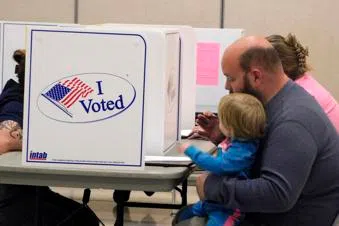
A man votes while holding a child at Valley View Elementary School Gym on Election Day, Tuesday, Nov. 5, 2024, in Rapid City, S.D. (Madison Willis/Rapid City Journal via AP)
SOUTH DAKOTA (South Dakota Searchlight) – A nonprofit organization and a Sioux Falls voter filed a lawsuit Monday in federal court over the implementation of South Dakota’s new proof-of-citizenship requirement for voter registration.
Senate Bill 175, passed by lawmakers and signed into law by Republican Gov. Larry Rhoden in March, requires documentary proof of citizenship from people registering to vote.
That proof can take forms including a birth certificate, passport, driver’s license, non-driver’s identification card or tribal identification card, or “any other type of acceptable documentary evidence of citizenship” under federal law. Photocopies are acceptable for any of the documents except driver’s licenses or state or tribal ID cards.
People who don’t provide those documents are registered but receive a “federal-only” ballot, meaning one that lists only candidates for federal offices such as the president and Congress, but not state or local offices.
In addition to proof of citizenship, the new law requires a person to provide a physical address in South Dakota, other than a mail-forwarding service or post office box, to be registered for voting in state and local elections. That provision — enforceable at the time of registration or upon a request for an absentee ballot — targets people such as full-time recreational vehicle drivers who may receive forwarded mail and register their vehicles in the state but otherwise don’t live there.
An analysis of voter data by South Dakota Searchlight in May showed that about 1,500 people in South Dakota had been registered as “federal only” since the law took effect with the governor’s signature in March.
The lawsuit alleges that South Dakota’s rollout of the proof-of-citizenship requirement has disqualified eligible voters over erroneous minutiae and failed to offer them a realistic shot at fixing problems with their registration application.
The lawsuit asks a judge to force the state to:
- Accept photocopies of driver’s licenses, tribal IDs and nondriver IDs for voter registration.
- Rescind guidance requiring in-person registration for people who use such IDs as proof of citizenship.
- Make sure registrants designated as federal-only are offered accurate explanations as to why they’ve been denied access to state and local ballots.
- Offer voters registered as federal-only an opportunity to challenge the designation.
The lawsuit also seeks a ruling that the non-acceptance of photocopies for state and tribal IDs violates the U.S. Civil Rights Act, and asks the state to pay the plaintiffs’ attorney fees.
Group’s proposed rule changes previously rejected
The League of Women Voters is a nonpartisan, nonprofit group that holds registration drives, provides voter education and lobbies on voting rights issues.
Members of its South Dakota chapter argued before the state’s Board of Elections for rule changes earlier this summer that would have addressed the issues raised in their lawsuit. The board voted the changes down 5-2, ruling that the League lacked the legal standing to propose them.
The League’s lawsuit, which also includes a Sioux Falls man named Jaysen Hill as a plaintiff, names South Dakota Secretary of State Monae Johnson, the state Board of Elections and each board member as defendants.
The lawsuit says the League’s representatives have tried to work with Johnson’s office to fix what they see as issues with the law’s administration, but that her office has been unwilling to do so.
The complaint says Minnehaha County registered Hill as federal-only after he applied to register by mail, sending a photocopy of his state identification card in May.
The card showed his address, the lawsuit says, but the letter he received telling him he’d be registered federal-only said he’d failed to provide a physical address. Hill was “confused” about the letter, which the lawsuit says is a form letter sent to those registered as federal-only.
Hill “now believes he was registered as a federal-only voter because he submitted a photocopy of a state identification card,” the lawsuit says, running afoul of the requirement to present the actual ID card.
“It was never made clear to Plaintiff Hill by any state or local officials that he was registered as a federal-only voter because he failed to provide documentary proof of citizenship, nor is it clear to Plaintiff Hill how he should go about fixing his application.”
Hill “was unable to participate” in the June 2 primary election, the lawsuit says.
State says it’s yet to see lawsuit
Hill and the League are represented by lawyers from the American Civil Liberties Union of South Dakota and the ACLU Foundation, a lawyer from the Sioux Falls law firm Heidepriem Purtell Siegel Hinrichs, and attorneys for the Campaign Legal Center, a nonpartisan legal aid organization in Washington, D.C., founded more than two decades ago by a former member of the Federal Election Commission.
Kathryn Johnson, president of the League of Women Voters’ South Dakota chapter, said in a press release that the state’s approach to the proof-of-citizenship issue “has not only effectively shut down our League’s ability to register new voters, but it has pointlessly caused voter confusion and made voting harder.”
Andrew Malone, a lawyer with the ACLU of South Dakota, said in the release that the case is about making sure the state’s new law is administered “in compliance with federal mandates.”
“There is no proof of widespread voter fraud or evidence of non-citizens voting that justifies a law that imposes burdensome show-your-papers requirements for eligible voters to cast their ballots,” Malone said.
Tony Mangan, spokesman for South Dakota Attorney General Marty Jackley, told South Dakota Searchlight on Monday evening that the office had yet to be served with the lawsuit.
Secretary of State Monae Johnson and a spokesman for her office did not immediately respond to a request for comment.




Comments